Tuesday, 12 July 2016

South China Sea: Hague rules in favor of Philippines over China

Hong Kong (CNN)    An international tribunal in the Hague ruled in favor of the Philippines in a maritime dispute Tuesday, concluding that there was no legal basis for China to claim historic rights to the bulk of the South China Sea.
China rejected the decision by the Permanent Court of Arbitration, which is likely to have lasting implications for the resource-rich hot spot, which includes one of the world's busiest sea lanes.
"China neither accepts nor recognizes it," the Ministry of Foreign Affairs said in a statement.
In a statement released straight after the ruling, the Philippines government said it "strongly affirms its respect for this milestone decision as an important contribution to ongoing disputes in the South China Sea."
The Tribunal concluded that China's doesn't have the right to marine resources within its "nine dash line," which extends hundreds of miles to the south and east of its island province of Hainan and covers some 90% of the disputed waters.
    Natalie Klein, an international law professor at Macquarie Law School in Australia, said the ruling was a "decisive win" for the Philippines.

    Heightened tensions

    Analysts said the ruling could heighten friction in a region already bristling with tension, especially if it provokes a defiant reaction from China.
    The ruling doesn't just affect China, but other countries that have competing claims with the nation over large areas of sea.
    Malaysia, Taiwan, Vietnam and Brunei have also taken exception to China's growing presence in the region, and could now be emboldened to take further action.
    "If China's nine-dash line is invalid as to the Philippines, it is equally invalid to those States and, indeed, the rest of the international community," the lawyers who led the Philippines legal team said in a statement.
    Japan, a key U.S. ally and China's neighbor, issued a statement saying it "strongly expects that the parties' compliance with this ruling will eventually lead to the peaceful settlement of disputes in the South China Sea."

    How will the U.S. respond?

    The United States is also major player in the region and has sent warships and military aircraft around the South China Sea, including near disputed reefs and shoals, citing international law and freedom of movement but triggering harsh warnings from China.
    The U.S. takes no position on the territorial disputes in the South China Sea, but has called for an immediate end to land reclamation.
    President Barack Obama has called for a peaceful resolution to the dispute and while visiting Vietnam in May, said that big nations shouldn't bully small ones.
    But as China has been at pains to point out, the U.S. isn't among the 180 countries that have ratified the United Nations Convention on the Law of the Sea (UNCLOS) -- potentially undermining its clout on this issue.
    High stakes surveillance over the South China Sea
    High stakes surveillance over the South China Sea 03:47

    The findings

    The Tribunal also found the none of the sea features claimed by China were capable of generating an Exclusive Economic Zone -- which gives country maritime rights to resources such as fish, and oil and gas within 200 nautical miles of that land mass.
    It deemed they were rocks or low-tide elevations such as reefs, rather than islands.
    Because China had no rights to the area as an Exclusive Economic Zone, the tribunal found that some of its activities in the region were in breach of the Philippines' sovereign rights.
    China had violated those rights by interfering in fishing and oil exploration, constructing artificial islands and failing to stop Chinese fisherman from fishing the zone, the ruling said.
    The panel found China had caused "severe harm" to coral around the site of its artificial islands. It had also "violated its obligation to preserve and protect fragile ecosystems."
    Chinese fisherman had also killed endangered sea turtles and giant clams "on a substantial scale" -- with the full knowledge of China, the tribunal found.
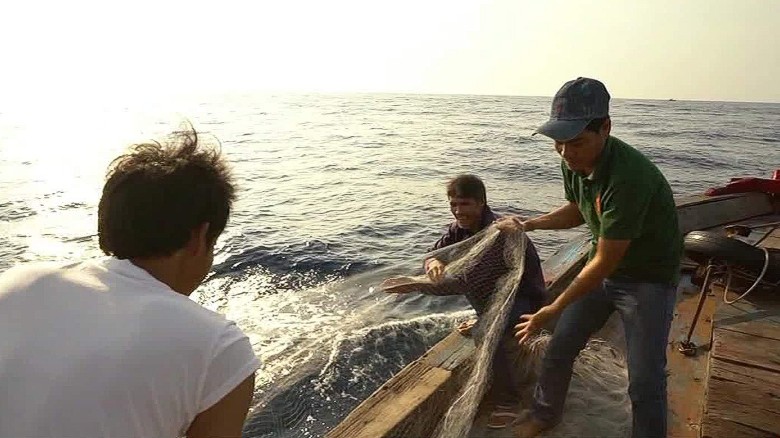
    Fishermen caught up in South China Sea tensions
    Fishermen caught up in South China Sea tensions 02:41

    How we got here

    The Philippines and China have long been at odds over Beijing's claims of sovereignty over large swathes of the South China Sea, and Manila took its fight to the Court in 2013.
    Tensions have ratcheted up as China has reclaimed land in massive dredging operations, turning sandbars into islands equipped with airfields, ports and lighthouses.
    China had refused to participate in the case, which marks the first time an international court has ruled on the region's mess of overlapping claims.
    Feelings were running high on both sides of the dispute in the run-up to the ruling Tuesday.
    In the Philippines, the hashtag #CHexit was trending on Twitter -- calling for China to leave the South China Sea.
    The topic was also the most widely discussed on Chinese social network Weibo, China's equivalent of Twitter, with hundreds of thousands of users sharing a map of China with its nine-dash line and the caption "China can't be one dash less."

    Showdown in the South China Sea: Timeline

    The South China Sea is home to a messy maritime dispute. China, Malaysia, the Philippines, Taiwan and Vietnam all dispute sovereignty of several island chains and nearby waters.

    1947

    Nine-dash line

    China publishes a map outlining its claims in the South China Sea. The map becomes the basis of the "nine-dash line" -- the foundation of China's current territorial claims.

    January 1974

    China occupies the Paracel Islands

    China builds a military installation on Woody Island with an airstrip and artificial harbor. It has occupied all the Paracel Islands since 1974, when Chinese troops seized a South Vietnamese garrison. The islands are also claimed by Taiwan and Vietnam.
    LOADING

    March 14, 1988

    Deadly skirmish

    Chinese and Vietnamese sailors square off over Johnson South Reef as the two countries scramble for a physical presence in the Spratlys. Vietnam says 64 of its soldiers were killed in the battle.
    LOADING

    November 4, 2002

    Declaration of conduct

    China and members of ASEAN sign a "Declaration on the Conduct of Parties in the South China Sea." The accord eases tensions but falls short of a legally binding code of conduct.

    May 2005 — 2006

    Taiwan builds airstrip

    Taiwan builds a a 1,200 meter runway at Itu Aba island, the only island it controls in the South China Sea and the largest naturally occuring island in the Spratlys.

    May 2009

    China makes submission to U.N.

    In a submission to the United Nations, China claims sovereignty over the islands in the South China Sea and adjacent waters. To support its claim, it attaches a map of the "nine-dash line" -- its claimed territorial waters that extend hundreds of miles to the south and east of its island province of Hainan. Vietnam and Malaysia object.
    LOADING

    November 2012

    New passports

    The Philippines and Vietnam condemn a new Chinese passport design that contains a map of China's disputed maritime claims in the South China Sea.

    January 2013

    Philippines vs. China

    The Philippines files a case with the Permanent Court of Arbitration in The Hague. It seeks a ruling on its right to exploit the South China Sea waters in its 200-nautical mile exclusive economic zone (EEZ) as allowed under the United Nations Convention on the Law of the Sea (UNCLOS). Beijing refuses to participate.
    LOADING

    April 2013

    Tourists arrive

    China says it has started allowing tourists to visit Woody Island in the Paracels as part of a cruise.

    May 2, 2014 — July 15, 2014

    Oil rig dispute

    Chinese oil company CNPC moves an oil exploration rig near to Triton Island in the Paracels. Anti-Chinese riots erupt in Vietnam, causing damage to businesses. Vietnamese vessels approach the rig but are stopped by Chinese boats. The standoff ends when China moves the rig on July 15, a month earlier than planned.
    LOADING

    November 2014

    Airstrip-capable island

    Satellite images analyzed by IHS Jane's Defence Weekly suggest China is building an island at Fiery Cross Reef in the Spratlys big enough for an airstrip.
    LOADING

    February 2015

    Island building

    Satellite imagery shows China building a "significant presence" in the Spratlys, reclaiming land at a total of five sites and building airstrips. IHS Jane's Defence Weekly describes it as a "methodical, well-planned campaign" to create a chain of air and sea capable "fortresses."
    LOADING

    May 2015

    U.S. plane warned

    China's Navy warns a U.S. surveillance plane carrying a CNN crew eight times as it flies over man-made islands in the Spratlys.

    June 16, 2015

    China says reclamation "almost finished"

    China says it has "almost completed" land reclamation in the South China Sea. According to the U.S., China has reclaimed some 3,000 acres of land since the beginning of 2014.

    October 26, 2015 — January 30, 2016

    U.S. tests freedom of navigation

    The United States sends a warship, the USS Lassen, within 12 nautical miles of one of China's man-made islands -- Fiery Cross Reef in the Spratlys. The U.S. conducts a similar "freedom of navigation" operation near Triton Island in the Paracel Islands January 30, 2016. China objects to both, tracking and warning the vessels.

    January 2016

    Test flights

    Chinese civilian airliners land on a freshly completed runway at Fiery Cross Reef, drawing objections from Vietnam.
    LOADING

    February 2016

    Missiles deployed

    China deploys surface-to-air missiles and fighter jets on Woody Island in the Paracels as U.S. President Obama meets with ASEAN leaders. Obama calls for a halt to construction or militarization in Asia's seas.

    Nine-dash line
    1947

    Nine-dash line

    China occupies the Paracel Islands

    Deadly skirmish

    Declaration of conduct

    Taiwan builds airstrip

    China makes submission to U.N.

    New passports

    Philippines vs. China

    Tourists arrive

    Oil rig dispute

    Airstrip-capable island

    Island building

    U.S. plane warned

    China says reclamation "almost finished"

    U.S. tests freedom of navigation

    Test flights

    Missiles deployed

    1770
    1780
    1790
    1800
    1810
    1820
    1830
    1840
    1850
    1860
    1870
    1880
    1890
    1900
    1910
    1920
    1930
    1940
    1950
    1960
    1970
    1980
    1990
    2000
    2010
    2020
    2030
    2040
    2050
    2060
    2070
    2080
    2090
    2100
    2110
    2120
    2130
    2140
    2150
    2160
    2170
    2180
    1929
    1931
    1932
    1933
    1934
    1935
    1936
    1937
    1938
    1939
    1941
    1942
    1943
    1944
    1945
    1946
    1947
    1948
    1949
    1951
    1952
    1953
    1954
    1955
    1956
    1957
    1958
    1959
    1961
    1962
    1963
    1964
    1965
    1966
    1967
    1968
    1969
    1971
    1972
    1973
    1974
    1975
    1976
    1977
    1978
    1979
    1981
    1982
    1983
    1984
    1985
    1986
    1987
    1988
    1989
    1991
    1992
    1993
    1994
    1995
    1996
    1997
    1998
    1999
    2001
    2002
    2003
    2004
    2005
    2006
    2007
    2008
    2009
    2011
    2012
    2013
    2014
    2015
    2016
    2017
    2018
    2019
    2021
    2022
    2023
    2024
    2025
    2026
    2027
    2028
    2029
    2031
    2032

    What happens now?

    Despite issuing what's considered a very strong ruling against China, there was nothing in the decision that points to what happens next.
    The Tribunal said that it "lacked the jurisdiction to consider the implications of a stand-off" between the Chinese and Philippines military, specifically at Second Thomas Shoal, and said that any resolution of the dispute was "excluded from compulsory settlement."
    The Tribunal hasn't ordered China to take any particular steps to remedy the situation, dismantle construction on the islands or provide reparations to the Philippines.
    And while the ruling is regarded as legally binding, there is no mechanism to enforce it.
    "In terms of enforcement, much will depend on what the Philippines is now prepared to assert against China based on the award and China's responses to those assertions, " said Klein.

    No comments:

    Post a Comment