Tuesday, 3 January 2017

At least 56 killed in Brazil prison riot over drug turf, officials say

(CNN)   A 17-hour uprising at a prison in Brazil claimed the lives of at least 56 prisoners over the weekend, state-run media agency Agencia Brasil reported Monday. Bodies were thrown over the wall of the complex, and at least six people were decapitated, the news agency reported.
    The revolt started Sunday afternoon as part of a rivalry between two criminal organizations at the Anisio Jobim Prison Complex in the city of Manaus, Agencia Brasil reported, citing Sergio Fontes, the public safety secretary for the state of Amazonas.
    CNN Map
    Site of Brazilian prison riot
    Rio de Janeiro
    Violence erupted on Sunday between incarcerated members of the the Familia do Norte (FDN) and the Primeiro Comando da Capital (PCC) groups. The riot lasted for more than 17 hours. The FDN controls drug trafficking and the "inside of prison complexes," according to state media. Fontes said that the riot started over control of the drug trade behind the prison walls.
    "They weren't fighting because one is called one thing and the other one is called another. They are fighting for money," he said.
    Military police officers track possible fugitives of the Anisio Jobim Penitentiary Complex after a 17-hour riot broke out Sunday.
    "There is a silent war going on, and the state must intervene. What is this war? Drug trafficking. What did we see today? One faction fighting with another." Among the hostages were 74 prisoners and an unknown number of prison guards, Fontes said. Authorities said they did not know how many prisoners might have escaped from the complex.
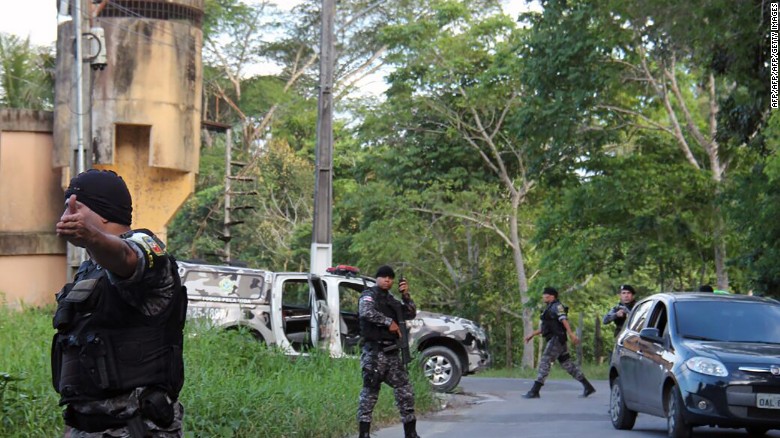
    Dozens of inmates were killed in the incident, and authorities have said they don't know how many have potentially escaped.

    Separate prison break

    As the riot raged, "dozens" of prisoners orchestrated an escape from another Manaus prison, the Antonio Trindade Penal Institute (Ipat). Fontes speculated that the jailbreak could have been arranged as a "smokescreen" for the Anisio Jobim riot, according to the Agencia Brasil report. Prisoners also caused a "commotion" at one other penitentiary, according to the Amazonas public security secretariat.
    Security forces did not enter the Anisio Jobim complex due to the "unpredictable" nature of the situation. According to Fontes, the riot "was managed with negotiation and respect for the human rights."
    He said said the riot instigators will be identified and held accountable for the murders and other crimes.
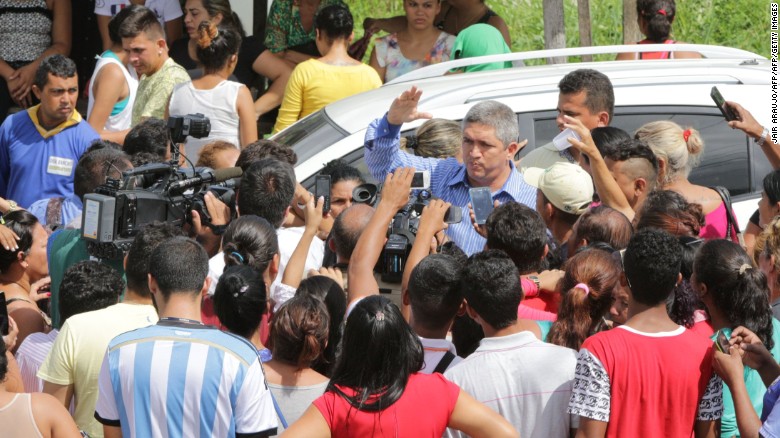
    An unidentified man speaks to relatives of inmates and to the media near the main gate prison complex.

    Extra funding requested

    Alexandre de Moraes, Brazil's justice minister, told reporters on Monday evening in Manaus, that the gang members responsible for the riot will be transferred to federal prisons. "This is an important step to identify and remove those that headed this absurd riot on the first of the year," he said.
    Following the New Year's incident, the government of the state of Amazonas has called for federal support to combat drug trafficking and strengthen security in Brazil's detention centers.
    Fontes said the preliminary investigation suggests the riot was premeditated. "Everything indicates that the acts were planned over a long period of time," he said. "The inmates had established with the administration (of the prison) a promise that everything would run smoothly throughout the holidays and there wouldn't be any problems. They didn't keep their promise, but you can't expect much from criminals, can you?"
    The number of prisoners killed in Sunday's incident is the highest since the deadly 1992 Carandiru massacre. In that case, 111 inmates died after police stormed the Carandiru penitentiary following a riot.

    4 children die when pesticide, water mix creates toxic gas

    (CNN)    Four children died after someone at their home sprayed water on an applied pesticide, causing a reaction that resulted in toxic gas, officials in Amarillo, Texas, said. At least five other people were hospitalized in Monday's incident.
      Fire Capt. Larry Davis said a family member used water to try to wash off the aluminum phosphide, which had been administered before by someone beneath the residence. The incident preliminarily has been ruled an accidental poisoning.
      There were 10 people inside the mobile home at the time of the incident, according to Davis. The children ranged in age from 7 to 17, CNN affiliate KVII reported.
      First responders went to the hospital for treatment of possible exposure. Several firefighters are being held for observation, according to KVII.
      Aluminum phosphide is listed in the Toxicity Category I by the U.S. Environmental Protection Agency -- the highest and most toxic category. Specifically, the EPA points to the "acute effects via the inhalation route."

      Istanbul attack: Teenager's first trip abroad ends in tragedy

      (CNN)  Leanne Nasser begged her parents to let her go to Istanbul. She had never been abroad. Never left Israel. Her three friends were going to the city on the Bosporus to celebrate New Year's Eve and she wanted to go with them. Her father refused. He was worried Istanbul wasn't safe and he wanted her to stay home. Despondent, she turned to her aunt, Layal Masarweh, who intervened on her behalf.
      "Her father was totally against that. He was saying that Istanbul is too dangerous and that she should not go at all. But she insisted, saying that nothing will happen to her," Masarweh told CNN.
      Nasser, 18, from Tira, an Arab town in central Israel, had big plans for the future after finishing high school in June. She worked at a dental clinic and was saving to buy a car. She wanted to be a dentist one day. But first was New Year's Eve and celebrating the start of 2017.
      The four women made their way to the Reina restaurant on the Bosporus in Istanbul. A few hours before midnight, she posted a picture to Snapchat. In it, she flashed a half-smile, a floral crown atop her long, dark hair. Her brown eyes looked straight at the camera.
      The following morning after a terrorist opened fire inside the club, after 39 people were killed and dozens more injured, after emergency responders started working through the massacre Nasser was missing.
      Her three friends were found two were uninjured. One was in the hospital, having sustained moderate injuries in the attack, but she was in stable condition and was expected to recover.
      Nasser's father caught the next flight to Turkey a 90-minute flight from Tel Aviv. Hours passed as her family held out hope. She might have survived. She might be in a different hospital. She might be OK.
      At home in Tira, her uncle's phone buzzed. It was her father. He had sent over some pictures. A heart-shaped gold ring with specks of blood on the band. A necklace with purple and green gemstones. A silver purse with blood that had seeped between the sparkles.
      The authorities were wondering if her family could identify them. And her father couldn't remember if they were Leanne's.
      The uncle stared at the pictures for a moment. He showed the photos to Nasser's aunt. There was no doubt anymore. They were Leanne's. She had died in the attack.
      "I cannot forgive myself," said her aunt, Layal Masarweh. "I wish I was with her to defend her or do anything to save her life. I wish they took my soul and gave it to her."
      Nasser's body will be flown home on Tuesday, three days into 2017. Her family is waiting for her to come home. The tears have not stopped, and the grief is still too near. "I still cannot believe it happened and that she was killed," Masarweh said. It was Leanne Nasser's first trip abroad. And it will be her last trip home.

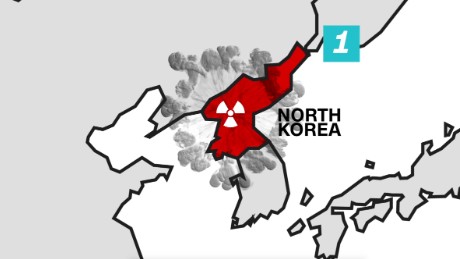
      Boxed into a corner? Donald Trump's limited options on North Korea

      (CNN)   President-elect Donald Trump has made a bold bet on North Korea, saying the secretive country won't test an intercontinental ballistic missile that could reach the United States. In his New Year address, North Korea's volatile leader Kim Jong Un said the country was close to doing just that. "It won't happen," Trump tweeted late Monday.
      He went on to repeat his claim that China wasn't doing enough to help the US rein in North Korea and its autocratic leader: "China has been taking out massive amounts of money & wealth from the US in totally one-sided trade, but won't help with North Korea. Nice!" Trump wrote.
      But, if his tweets are any guide, analysts say that Trump has backed himself into a corner on North Korea. They say Trump needs to reach for a new playbook if he really wants to stop Kim from adding to his arsenal a rocket powerful enough to reach any part of the US. It boils down to these four options.

      1. Pulling strings with China

      Since winning the election, Trump has suggested at least twice that China North Korea's economic benefactor and only real ally isn't pulling its weight when it comes to reining in Kim Jong Un's regime. But analysts say Beijing has no magic wand and is both unwilling and increasingly unable to influence its unruly neighbor. Tong Zhao, an associate at Carnegie-Tsinghua Center for Global Policy in Beijing, says that engagement between top level North Korean and Chinese officials has been suspended for quite a while.
      "China is frustrated by its inability to push North Korea," said Zhao.
      Trump could try and force China to cooperate by undermining its interests elsewhere -- launching a trade war or confronting Beijing over Taiwan or the South China Sea but it would be a high-stakes move, that Zhao says would trigger a "huge negative response."
      "From a US-China perspective, it would be a huge waste of (political) capital and energy going after them on North Korea when the US could approach North Korea directly trying to get them to do something on North Korea," says John Delury, associate professor of Chinese studies at Yonsei University in Seoul.
      North Korea: The biggest issue for the next US president?
      North Korea: The biggest issue for the next US president? 00:38

      2. Tightening sanctions

      Trump could push China to beef up and implement existing sanctions more harshly but there's no evidence that sanctions have any impact on North Korea's decision making, says Jeffrey Lewis, director of the US-based East Asia Nonproliferation Program.
      "It allows the US and our allies to look busy while the North develops an ICBM," he said.
      Zhao says that tougher sanctions may risk more brinkmanship -- Kim is a man who can't be bought off.
      "I don't see how North Korea will soften its position. They see a nuclear deterrent as absolutely crucial to ensure the country's survival. Only once they have it, will they devote resources to the economy."

      3. Launching military action

      It's still a matter of debate how big a risk North Korea poses militarily and whether it could really put a nuclear warhead on a missile. It conducted two nuclear tests in 2016, one in January, and another in September, it's most powerful ever. It's also tested a string of missiles, both land and sea launched. So far, North Korea hasn't developed a delivery system capable of reaching beyond Asia but the fact North Korea remains the only country on Earth to test a nuclear weapon in the 21st century means that any military effort to take out Kim's regime is unimaginably high risk.
      North Korea's closest neighbors are the most vulnerable targets to nuclear or conventional weapons, of which Pyongyang has an ample arsenal. South Korea would have to be prepared for potential devastation if Kim were to strike.
      "It's not a viable option. We are way past pre-emption," said Delury. There are few other aggressive actions available, he added. North Korea has no diplomats the US could expel. "North Korea is hard to punish because it has so little to lose. This is why it's different to Iran where there was an economy integrated with Europe, a middle class that we could use as leverage." 

      4. Sitting down with Kim

      On the campaign trail, Trump said he would be happy to host Kim for a visit, saying in June "what the hell is wrong with speaking?" The comment appeared off the cuff and hasn't been repeated but Zhao and Delury both said that engagement was the only option if Trump wanted to make any head way with North Korea. "I do think it's the way forward. It was a fleeting moment of Trumpian brilliance. He has the right instincts," Delury said.
      A US president meeting with the leader of a rogue regime known for its massive human rights abuses would be a hard sell domestically, Delury stressed, but wild card Trump might be capable of pulling it off.
      "You could imagine Trump in Pyongyang in a way you couldn't imagine Hillary Clinton," he said. Zhao said that North Korea had refrained from making any provocations since October and appeared to be willing to engage with a Trump administration.
      Trump could potentially be the "American president who prevented North Korea from obtaining the ability to strike the US with a nuclear weapon," Zhao added. "You only get a big breakthrough when two leaders actually talk to each other."